
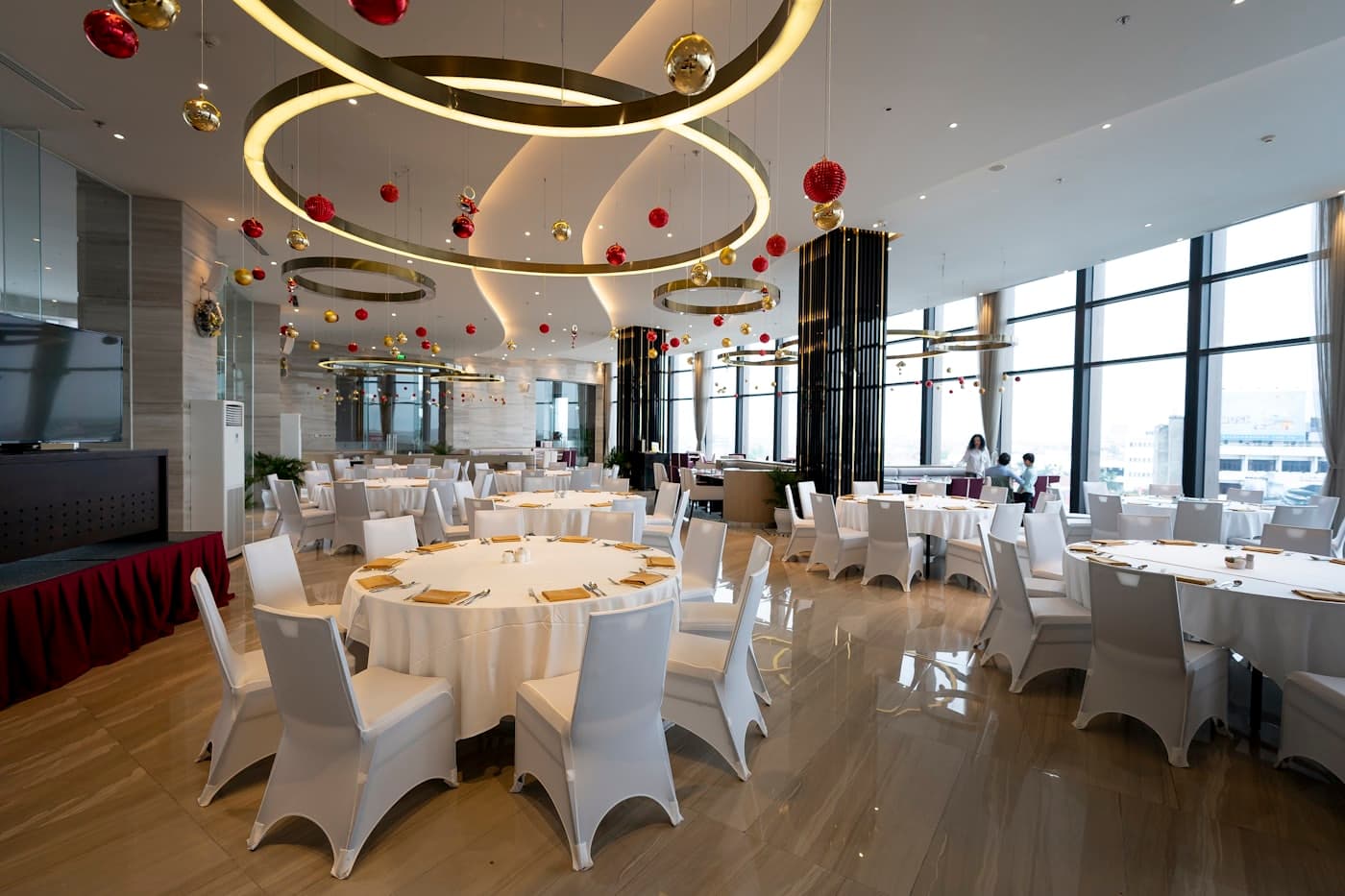
Renting or buying your reception equipment: the arithmetic
· 6 min read
From how many events a year does buying pay off? The full calculation, hidden costs included — and why the answer often comes as a surprise.
The question keeps coming from hotels, event venues and caterers as their business grows: "with all this renting, wouldn't we be better off buying?" The answer depends on three figures, and rarely on the one that comes to mind first.
The apparent calculation
Take two hundred banquet chairs.
- Renting: a price per chair per event.
- Buying: a unit price, once.
Divide the purchase by the rental and you get the number of events from which buying would pay off. On simple furniture, that threshold often falls between fifteen and twenty-five uses.
That calculation decides most purchases. It is also the one that leaves out what matters.
The four costs the apparent calculation ignores
Storage. Two hundred chairs and twenty round tables take up some forty square metres, under cover and dry. In a rented unit in Lomé, that is a monthly cost that runs whether the equipment is used or not.
Transport and handling. Renting means buying delivery, set-up and collection too. Owning means having a suitable vehicle, staff to load it, and time.
Upkeep and replacement. A banquet chair degrades mainly in transport, not in use. Count 10 to 15 % annual replacement on furniture that moves regularly, more on tableware and glassware. Bought stock is never a frozen investment: it is a recurring cost line.
Rigidity. This is the heaviest cost, and the only one that cannot be put in figures. A stock of two hundred chairs serves receptions of two hundred people admirably. For five hundred, you rent the difference — often in a different model, which shows in the room. For eighty, you have paid to store a hundred and twenty unused chairs.
The real calculation
The real break-even point, full costs included, sits closer to forty to sixty uses a year for standard furniture — that is, sustained activity that is also steady in volume.
Three profiles emerge:
Buying makes sense if you run more than one event a week, at comparable volume, in a fixed venue — a hotel with its own function room, an event hall. The equipment barely moves, wear is low, storage already exists.
Renting makes sense if your volumes vary, if your events take place somewhere other than your own premises, or if you want to change style from one reception to the next.
A mix often makes the most sense: own the core that is used every time — the chairs of a fixed venue, a few tables — and rent everything that varies, tableware first. That is the arrangement most of the professionals we work with settle on.
The special case of tableware
Tableware deserves its own reasoning. It breaks, it goes mismatched, and it needs washing — washing to standard, with drying and inspection before storage.
A full range for three hundred covers loses, in our experience, a tenth of its pieces a year. Replacing it identically assumes the model is still being imported, which is never guaranteed over three years.
This is the item where renting keeps the advantage longest, even at high volume.
What we do about it
We rent, and we also supply for purchase through the Equipment branch: we therefore have no interest in pushing one over the other.
In practice, we often advise a growing hotel to buy its chairs and keep renting its tableware. It is not the best sales pitch, but it is the advice that holds up over three years.
More benchmarks worth knowing
Equipment for a traditional ceremony
Dowry, blessing, end-of-mourning: these ceremonies are not sized like a Western reception. What changes, and why.
Outdoor receptions, season by season
Harmattan, June downpours, September humidity — what each season demands of the equipment, the marquee and the schedule of a reception in Lomé.
Let's talk about your next project
Date, venue, number of guests — or an equipment list, a brief, a farm to equip: you receive a costed proposal within 24 hours.